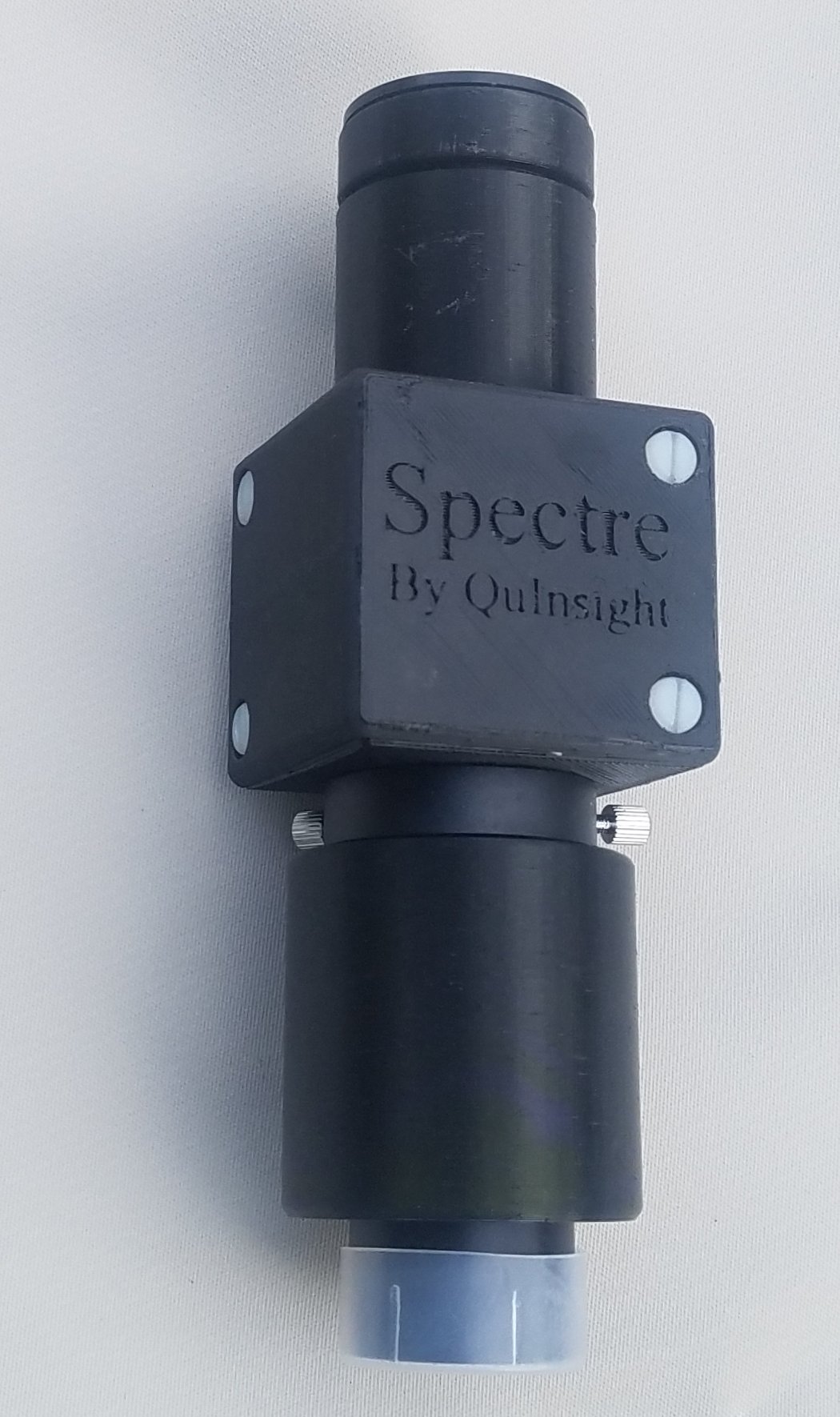

Spectre Spectroscope
high performance visual spectroscope for amateur astronomy
The Spectre spectroscope creates high-resolution colorful spectra of most bright stars and shows finely detailed absorption lines. Unlock the Secrets of the Universe!
Features & Specifications
Straight-through configuration enabled by "grism" design. Green is centered in the field of view!
High Efficiency Holographic Grating: 516 lines/mm bonded to Bk7 prism
No undiffracted starlight in field of view
Includes Orion Shorty 2X Barlow in 2” adapter, collimates beam going into grating assembly
(removable for standalone use)
3D printed housing in PETG
AR coated optics
Accepts 1.25″ eyepieces, recommended focal lengths from 7 mm to 22 mm, works nicely with zoom eyepieces.
June 2, 2020
From: Howard Banich, Sky and Telescope Contributing Editor
WOW!!!
I received the Spectre and set up the 28-inch in my backyard. Hoping for the best, I ended up enjoying one of the most memorable nights of observing I've ever had because of the highly detailed spectra your Spectre produces. It's been a long time since I gasped so many times while looking through a telescope.
Arcturus was especially detailed, but so was Antares. Polaris showed a surprisingly detailed spectrum. Vega's two absorption bands in the blue and purple were dark, bold and thin along with two broad dark zones in the far red. But Arcturus was the most incredible - I could not sketch, let alone count, how many lines I saw - a hundred? Two hundred? A lot.
For the first half of the evening I was swapping between my 20, 15, 11 and 8 mm Plossl eyepieces, when it dawned on me to try the Televue 24 mm to 7 mm zoom eyepiece I use in my optical finder. That bumped things up another notch, and is a distinct improvement on fixed focal length eyepieces. At first I just swapped the zoom without re-initializing it on a streetlight, and even so the number of spider-web thin absorption bands in Arcturus spectrum was amazing, especially at the 7 mm setting. By the way, every setting of the zoom was as good as the others once initialized on the streetlight, and almost no re-focusing was needed when zooming in or out while observing - a real treat.
After initializing the zoom, the number of faint bands was even greater, and clearly extended all the way to the end of the purple. The red end had several wide, undulating dark zones, perhaps very thin, closely spaced absorption bands? Light blue through orange clearly showed the most bands though, and on a night with steadier seeing I imagine that even more could be seen.
At low power the colors were as saturated and as pure as the Rainbow Optics unit, and gradually became subdued as the power was increased. Even at the 7 mm setting the colors were still quite obvious though.
Well done Rob, I'm so very impressed! I'm hoping for some clear skies again tonight, and I'll try the Spectre in my 8-inch scope too.
Howard